What Is RTP in Online Casinos? Return to Player Explained
Best Non GamStop Casino UK 2026
Loading...
RTP: The Most Important Number Most Players Ignore
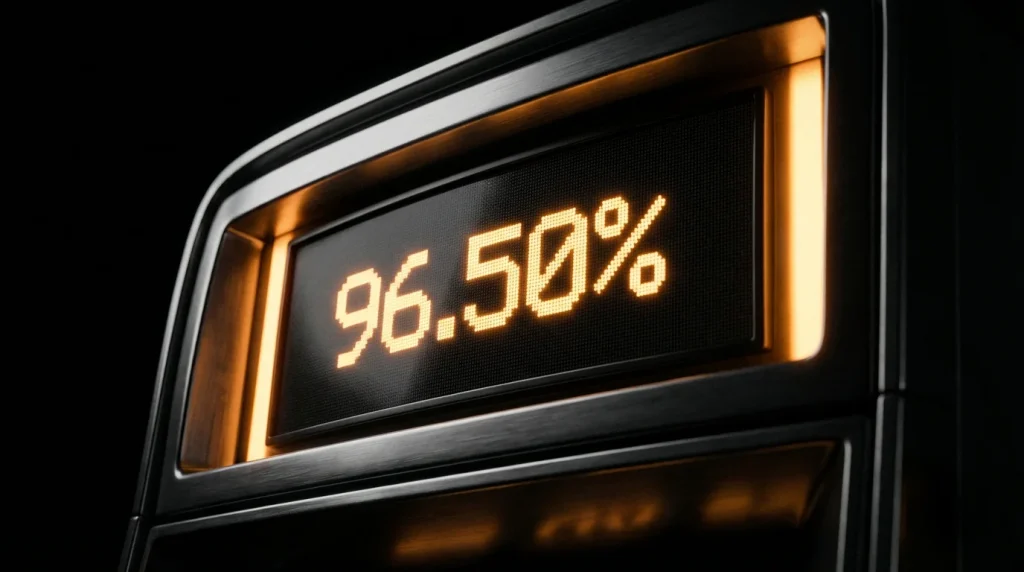
Every casino game has a published return-to-player percentage, and most players scroll past it without a second glance. That number — typically displayed as something like 96.50% or 97.30% — is the single most reliable predictor of how much a game will cost you over time. Not per spin, not per session, but over the lifetime of your play on that specific title. It tells you, in a single figure, what share of every pound wagered the game is designed to return to players as a collective group.
The emphasis on “collective” matters. RTP is not a promise about your individual experience. It’s a statistical average calculated over millions of simulated spins, describing the long-term behaviour of the game’s mathematics. In any single session, your results can deviate wildly from the published percentage — that’s variance at work. But over thousands of spins, the actual returns converge toward the RTP with increasing precision. It’s the mathematical gravity of every casino game: you can jump above it temporarily, but you always come back down.
Understanding RTP properly changes how you choose games, how you evaluate bonuses, and how you set realistic expectations for your bankroll. It won’t make you a winner — nothing can, over sufficient time, when the house holds any edge at all — but it will make you a more informed player who loses less per hour of entertainment. And in a casino, losing less is the closest thing to winning.
Return to Player Defined: What the Percentage Actually Means
RTP stands for Return to Player. It’s expressed as a percentage of total money wagered that a game is programmed to pay back over its operational lifetime. An RTP of 96.00% means that for every £100 wagered across all players and all spins, the game returns £96.00 and retains £4.00. That retained £4.00 is the house edge — the casino’s built-in profit margin.
The relationship between RTP and house edge is simple: they add up to 100%. A game with 96.50% RTP has a 3.50% house edge. A game with 99.50% RTP has a 0.50% house edge. Lower RTP means higher house edge, which means the game costs more to play per pound wagered. This is the core equation of every casino game, and it applies equally to slots, table games, live dealer, and everything in between.
RTP is calculated theoretically, not empirically. Game developers use mathematical models and extensive simulation — typically running billions of virtual spins — to determine the precise return percentage based on the game’s paytable, reel configuration, bonus mechanics, and hit frequency. The result is then certified by an independent testing lab (eCOGRA, GLI, BMM Testlabs) before the game is approved for use at licensed casinos. What you see published as the RTP is this certified theoretical figure, not a measurement of how the game has actually performed at any particular casino.
This distinction matters because short-term results routinely diverge from the theoretical RTP. A slot with 96.00% RTP might return 120% over a hundred spins for one player and 70% for another. Neither result contradicts the published RTP because the percentage describes behaviour over millions of outcomes, not hundreds. The larger the sample of spins, the closer the observed return gets to the theoretical figure. Over tens of thousands of spins, the convergence becomes tight. Over hundreds, it’s practically meaningless.
One common misunderstanding: RTP does not mean you’ll get back 96p of every pound you bet. It means that the game’s mathematical structure is designed to return 96% of total wagered volume to players as a group. Your individual outcome on any given session is determined by variance — the random distribution of wins and losses around the expected average. RTP sets the centre line; variance determines how far from that line any single session can land.
For table games, RTP depends on how you play. Blackjack has a theoretical RTP of 99.5% or higher — but only if you follow optimal basic strategy on every hand. Deviate from perfect play and the effective RTP drops, sometimes substantially. Roulette RTP is fixed at 97.30% for European and 94.74% for American because the game has no decision points that affect the outcome. Slot RTP is also fixed for the same reason: the player’s only action is pressing spin.
RTP in Practice: What It Means for Your Sessions and Your Bankroll
The practical impact of RTP on your bankroll is best understood through the concept of expected cost per hour. If you play a slot with 96% RTP at £1 per spin and average 600 spins per hour, your total wagered per hour is £600. The expected house take is 4% of £600 = £24. That’s the theoretical cost of one hour of play on that game at that stake. Switch to a slot with 94% RTP under the same conditions and the cost rises to £36 per hour — a 50% increase for a two-percentage-point drop in RTP.
Those per-hour figures illustrate why RTP differences that look small on paper matter over real playing time. The gap between a 94% slot and a 97% slot is three percentage points, which sounds negligible. But over £600 in hourly wagers, that gap translates to £18 more per hour retained in the 97% game. Across a month of regular play — say, ten hours total — the difference is £180. Choosing higher-RTP games doesn’t guarantee better sessions, but it systematically reduces the rate at which your bankroll erodes.
This is also why RTP matters enormously when clearing bonus wagering requirements. If you need to wager £3,000 to clear a bonus, the game’s RTP directly determines how much of your balance survives the process. At 97% RTP, your expected loss over £3,000 in wagers is £90. At 94%, it’s £180. The bonus terms might be identical in both scenarios, but the game you choose to play through those terms can halve or double your expected cost. Selecting the highest-RTP eligible slot is the single most impactful decision you can make during bonus play.
RTP interacts with volatility to shape the texture of your sessions. Two slots can share identical RTP but deliver completely different experiences. A low-volatility 96% slot returns frequent small wins, producing a smooth, gradually declining balance that closely tracks the theoretical loss curve. A high-volatility 96% slot delivers rare large wins separated by long dry spells, creating dramatic swings above and below the expected line. Over infinite spins, both converge on the same 96% return. Over a finite session, the high-volatility game is far more likely to produce either a significant win or a rapid wipeout. RTP tells you the cost; volatility tells you the ride.
A practical rule of thumb: for recreational play where you want to maximise session length on a fixed budget, prioritise low-volatility games with high RTP. For play where you’re comfortable with the possibility of losing your session budget quickly in exchange for a chance at a larger single win, high-volatility games with high RTP are the better fit. In both cases, “high RTP” is the non-negotiable constant. There’s no scenario where choosing a lower-RTP game benefits you mathematically.
One caveat applies to progressive jackpot slots. Their published RTP often includes the contribution to the progressive pool, meaning the base game RTP is lower than the headline figure. A progressive slot listed at 96% might have a base game RTP of 93% with 3% feeding the jackpot. Unless you win the jackpot, the game plays at 93% — a significant difference. If jackpot play appeals to you, that’s a conscious trade-off. Just be aware that the ticket price for a chance at the jackpot is baked into every spin as a reduced base return.
How to Find RTP Information for Any Casino Game
Finding the RTP for a specific game should be simple, but the reality is inconsistent across operators and providers. Some casinos make it easy; others make it an exercise in detective work. Here’s where to look, in order of reliability.
The game itself is the best primary source. Most slots from reputable providers display the RTP in the help or information section accessible from the in-game menu. Open the game, tap the menu icon (usually three horizontal lines or a question mark), and navigate to the rules or paytable section. The RTP is typically listed near the bottom, often alongside volatility information and maximum win details. This figure is specific to the version of the game running at that casino — which matters, because some providers offer operators the option to choose between multiple RTP settings for the same title.
That last point deserves emphasis. A growing number of slot providers release games with two or three RTP configurations — for example, 96.50%, 94.00%, and 87.00%. The casino operator selects which version to offer. The difference between these versions is invisible during gameplay; the slot looks and feels identical. Only the return percentage changes. This practice is fully legal and disclosed in the game rules, but it means you cannot assume a slot’s RTP is the same at every casino. Always check the specific game’s info screen at the casino where you’re playing.
If the game doesn’t display RTP directly, check the casino’s help section or terms page. Some operators publish a complete RTP list for all games on their platform, often as a downloadable document or a searchable page within their help centre. UKGC regulations require licensed operators to make RTP information available to players, though the regulations don’t specify exactly how prominent or accessible that information must be.
Game provider websites are another reliable source, though they typically publish only the maximum RTP configuration. If a provider lists a slot at 96.50% on their own site, that’s the highest available setting — the casino you’re playing at may have selected a lower one. Cross-referencing the provider’s published figure with the in-game display at your chosen casino is the most thorough approach.
Avoid relying solely on third-party review sites for RTP data. Many aggregate databases haven’t been updated to reflect the multiple-configuration reality, and they often list the highest available RTP regardless of what any specific casino is actually running. The in-game information remains the only definitive source for the version you’re actually playing.
The Number Behind the Number
RTP is the number behind every casino game’s economics. It’s the answer to the question every player should ask before pressing spin: what does this game cost me to play? Not the bet size per round — that’s your choice. The cost is the percentage of every wager that the game is designed to keep. A 96% RTP means the cost is 4p per pound. A 93% RTP means 7p per pound. Over a hundred pounds wagered, that’s the difference between losing £4 and losing £7. Over a thousand, it’s £40 versus £70.
You can’t control the outcome of any single spin. You can control which game you sit down at, and the RTP of that game determines the long-term drag on your bankroll. Higher RTP means less drag. Lower RTP means more. Neither eliminates the cost entirely — that’s what the house edge ensures — but the difference between a well-chosen game and a poorly chosen one accumulates steadily into real money over time.
Check the RTP before you play. Every time. It takes thirty seconds and it’s the single most effective way to reduce the cost of your entertainment at an online casino.