
Best Online Casino Real Money UK — The Complete Guide
UKGC-licensed casinos rated for bonuses, payout speed, game quality and safety.

Best Non GamStop Casino UK 2026
Loading...
Contents
What Makes a Real Money Casino Worth Your Deposit
Choosing the wrong online casino does not just waste your evening — it wastes your money. A slow withdrawal, a bonus with punishing wagering terms, or a missing UKGC licence can turn what should be entertainment into a frustrating exercise in reading small print you never agreed to read. This guide exists to cut through the noise of affiliate listicles that rank casinos by commission and instead give you a structured, methodology-driven framework for finding the best online casino for real money play in the UK.
Hundreds of UKGC-licensed casinos compete for your bankroll — and most of them are mediocre. They offer near-identical game libraries sourced from the same handful of providers, wrap them in welcome bonuses designed to sound generous while performing badly, and rely on the assumption that you will not check their withdrawal timelines until after you have deposited. The difference between a good real money casino and a mediocre one rarely shows up on the homepage. It shows up when you try to cash out your first win.
What separates the best casino sites UK players can actually trust comes down to a short list of verifiable criteria: a current, unconditional UKGC licence; payout speeds measured in hours rather than days; bonus terms with wagering requirements you can realistically clear; a game catalogue deep enough to sustain more than a single session; and responsive customer support that does not route you through a chatbot loop. These are not subjective preferences — they are measurable standards, and every casino on this page was scored against them.
This article walks through the methodology we use, ranks the top real money casinos operating in the UK in 2026, and then breaks down every factor that matters: bonuses, game selection, house edge, payment methods, safety, and mobile performance. If you have ten minutes, you will have enough information to make a decision you will not regret. If you have longer, the deep dives into RTP, bonus maths, and regulatory changes will arm you with knowledge most players never bother to acquire.
UKGC Key Fact
The UK Gambling Commission regulates 2,179 licensed gambling operators as of 31 March 2025, generating a combined Gross Gambling Yield of £16.8 billion (Gambling Commission Industry Statistics, November 2025). From 30 June 2026, all online operators must offer customers the opportunity to set a deposit limit based solely on gross deposits — a significant shift in how player spending is managed across the industry (Gambling Commission, October 2025). The first phase of these changes, requiring operators to prompt new customers to set limits before their first deposit, has been in effect since October 2025.
How We Rate: Methodology Behind the Rankings
Every casino on this page was scored against seven weighted criteria. This is not a subjective vibe check or a list ordered by who pays the highest affiliate commission. Each criterion is assigned a weight reflecting its importance to a real-money player, and casinos must pass a minimum threshold in every category to appear in our rankings at all. A perfect score in game variety cannot compensate for a failed licence check.
The scoring framework was developed from the ground up, drawing on real-money testing across dozens of UK casino sites. We deposited, played, requested withdrawals, contacted support, tested mobile performance, and documented the results. Ratings are reviewed quarterly, and any casino that drops below the minimum threshold in any category is removed until it resolves the issue. This is not a set-and-forget list — it reflects current conditions.
The seven criteria, in order of weight: UKGC licensing carries the highest weight — no licence, no listing. Payout speed is second because the withdrawal is when a casino reveals its true priorities. Bonus fairness examines wagering requirements, contribution rates, time limits, and win caps. Game quality and variety evaluates catalogue breadth across slots, table games, live dealer, and specialty titles. Mobile experience assesses performance and feature parity between desktop and mobile. Customer support is scored on response time and resolution quality — tested with real enquiries. Responsible gambling tools measure the accessibility of deposit limits, session timers, and self-exclusion options.
Our 7-Point Scoring Checklist
- UKGC licence — valid, unconditional, verified against the public register
- Payout speed — tested withdrawal times by method, including pending periods
- Bonus fairness — wagering requirements, contribution rates, caps, and time limits
- Game quality and variety — provider count, catalogue depth, RTP transparency
- Mobile experience — load times, interface quality, live dealer on mobile
- Customer support — response time, channel availability, resolution quality
- Responsible gambling tools — deposit limits, session timers, self-exclusion access
A casino can score well on six criteria and still not make the list. The threshold model means that a single critical failure — particularly in licensing or payout reliability — disqualifies a site entirely. This is deliberate. A player who chooses a casino based on our ranking should never encounter a fundamental trust issue. The nuances — which casino is best for slots versus live dealer, or which has the fastest PayPal withdrawals — are where the differentiation happens among the sites that already cleared every bar.
Best Real Money Casinos UK — 2026 Ratings
These are the casinos that passed every test — the rest didn't. What follows is not an exhaustive list of every licensed operator in the UK. It is a curated selection of the sites that scored highest across all seven criteria after real-money testing, withdrawal documentation, and quarterly re-evaluation. Each mini-profile highlights genuine strengths, standout features, and — because no site is perfect — at least one honest weakness.
Best for Game Variety
3,000+ titles from 80+ providers. Welcome offer with competitive wagering terms. E-wallet withdrawals processed within 24 hours. Strong live casino lobby powered by Evolution and Pragmatic Play.
Best for Fast Payouts
E-wallet cashouts consistently under 4 hours. Streamlined KYC process that rarely delays first withdrawals beyond 24 hours. Solid slots selection, though the live casino offering is narrower than some competitors.
Best for Bonus Value
Welcome bonus with below-average wagering requirement and no win cap on deposit match. Broad game contribution rates. Payout speed is average rather than exceptional — typically 1–2 business days for debit cards.
Best for Live Casino
Dedicated Evolution live environment with exclusive tables. Extensive range of live blackjack, roulette, and game show titles. Mobile live dealer performance is best-in-class. Slots catalogue is respectable but not the deepest on this list.

Best Established Casino Sites UK
Longevity in the UK casino market is not a guarantee of quality, but it is a useful data point. An operator that has held a UKGC licence for a decade or more has survived regulatory tightening, market shifts, and the kind of scrutiny that forces weaker operators out. The established sites below have track records measured in years of payout data, not months.
The first standout among established operators maintains payout speeds in the top tier of the industry. Its game library exceeds 3,000 titles from more than 80 providers, covering every major category. The welcome bonus reflects the current regulatory environment: reasonable wagering, no hidden game restrictions, and a clear maximum bet cap. Where it falls short is customer support response times during peak hours.
A second established operator earns its place through withdrawal reliability. In our testing, e-wallet cashouts cleared in under four hours every time. The game catalogue sits around 2,000 titles with strong representation from NetEnt, Play'n GO, and Pragmatic Play. The loyalty programme feels dated compared to newer competitors.
The third established site distinguishes itself through its live casino environment. A dedicated Evolution studio with exclusive tables means lower wait times and a more curated experience. Table limits range from pennies to four figures. The trade-off is a slots selection that, while adequate, does not push into the 3,000-title territory of the most game-heavy competitors.
Best New Casino Sites Worth Trying
New does not automatically mean untested. The casinos below launched within the past eighteen months but have already accumulated enough data — through our testing and wider player feedback — to justify a recommendation. New entrants often have to try harder, which means sharper bonuses, faster support, and more modern interfaces. The risk is lower track record. The reward is a willingness to compete on terms that benefit the player.
One recently launched site entered the market with a mobile-first design that shows. The interface is clean, live dealer on mobile is genuinely superior to most established operators, and the welcome bonus undercuts the competition on wagering requirements. The initial library of around 1,500 titles is growing monthly. The caution is that withdrawal processing has occasionally shown inconsistency during our first months of monitoring.
Another newer operator has carved a niche by focusing on transparency. Bonus terms are displayed prominently before deposit, RTP figures are listed for every game, and responsible gambling tools are front and centre. The game count is modest but curated, with a focus on high-RTP slots and a selective live casino offering. It appeals to informed players who value clarity over volume.
Casino Bonuses: What's Actually Worth Claiming
Most casino bonuses are designed to look generous and perform badly. A headline figure of "100% up to £200" sounds like free money until you read the terms and realise the gap between marketed value and real value is where operators make their margin — and where most players lose theirs.
UK casino bonuses fall into three main categories: deposit match bonuses, free spins, and cashback. Each works differently, each has a distinct risk profile, and each can range from genuinely valuable to functionally worthless depending on the attached terms. Since 19 January 2026, UKGC rules cap wagering requirements at 10x on bonus funds (Gambling Commission, March 2025) — a significant change that has compressed the gap between the best and worst offers, though the details still matter.
Deposit Match vs Free Spins vs Cashback
A deposit match bonus adds a percentage of your deposit as bonus funds. A 100% match up to £100 means you deposit £100, receive £100 in bonus money, and play with £200. The catch is the wagering requirement. Under the new 10x cap, a £100 bonus requires £1,000 in total wagers before withdrawal. That is significantly more achievable than the 35x requirements that were standard before the regulatory change, but it still means cycling through your balance multiple times.
Free spins are typically offered on specific slot games, with each spin assigned a fixed value — commonly £0.10 or £0.20. Fifty free spins at £0.10 each represent a total bonus value of £5, not the headline "50 FREE SPINS!" that the marketing implies. Winnings from free spins are usually credited as bonus funds subject to their own wagering requirement, and many offers impose a win cap — a maximum amount you can withdraw regardless of what you actually win. A win cap of £50 on a free spins offer means that even if you hit a 500x multiplier, you walk away with fifty pounds.
Cashback offers return a percentage of your net losses over a defined period, typically 5% to 15%. The strongest cashback deals pay as withdrawable cash with no wagering attached — true cashback. Weaker versions credit the cashback as bonus funds, reintroducing wagering requirements through the back door. Cashback is generally the lowest-risk bonus type because it only activates when you are already losing, functioning as a partial safety net rather than an incentive to deposit more.
How to Read Bonus Terms Without Getting Burned
The wagering requirement is the single most important number, but it is not the only one. Game contribution rates determine how efficiently different games clear the requirement. Slots typically contribute 100%. Table games often contribute 10% to 20%, and some — particularly low-edge games like blackjack — may be excluded entirely. If you primarily play table games, a bonus with 100% slots contribution and 10% table contribution is worth roughly a tenth of its face value to you.
Time limits are the silent killer of otherwise reasonable bonuses. A 30-day expiry on a 10x requirement for a £100 bonus means roughly £33 per day in required wagering — manageable. But always check the clock before you check the multiplier.
Maximum bet caps during bonus play restrict the amount you can wager on a single spin or hand while bonus funds are active, typically £5. Exceeding the cap — even accidentally — can void the bonus and all associated winnings. This is the single most common reason players lose bonus-derived winnings.
Bonus Value Calculation: 100% Match up to £100
Deposit: £100. Bonus received: £100. Total playable balance: £200.
Wagering requirement: 10x bonus amount = 10 x £100 = £1,000 in total wagers.
Expected house edge on slots (average): 4% = £0.04 lost per £1 wagered.
Expected loss from wagering: £1,000 x 0.04 = £40.
Expected remaining balance after clearing: £200 - £40 = £160.
Net bonus value: £160 - £100 (your deposit) = £60 real expected value.
Under the old 35x standard: £3,500 x 0.04 = £140 expected loss. Remaining: £60. Net value: -£40. The bonus would have cost you money.
The worked example above illustrates why the 10x wagering cap is a genuine improvement for UK players. At 35x, the expected loss from clearing the requirement exceeded the bonus itself — a negative-value offer dressed up as a gift. At 10x, the same bonus structure delivers meaningful positive expected value. But the calculation still depends on what you play. Switch from 96% RTP slots to a 98.5% RTP blackjack variant that only contributes 10% to the requirement, and the numbers shift dramatically because you need to wager ten times more in real terms.
Casino Games at UK Sites: What You Can Actually Play
The game library is where casinos differentiate — or fail to. Two UKGC-licensed sites can look identical in terms of licensing and bonus structure yet offer radically different playing experiences based on which game providers they partner with. A casino with 3,000 titles from 80 providers gives you genuine variety. A casino with 3,000 titles from 15 providers, half of which are reskinned clones, gives you the illusion of it.
UK casino game libraries in 2026 span five main categories: online slots, table games, live dealer, game shows, and specialty titles such as crash games and Slingo. The balance between these categories varies by operator, and understanding what each offers helps you match a casino's strengths to your actual playing preferences rather than being dazzled by a raw game count.
Slots
Typical count: 1,000–3,000+ titles. RTP range: 92%–98%. The dominant category at every UK casino, covering classic three-reel, video slots, Megaways, jackpot progressives, and branded titles. Key providers include Pragmatic Play, NetEnt, Play'n GO, and Big Time Gaming.
Table Games
Typical count: 50–200 titles. RTP range: 97%–99.5%. Digital versions of blackjack, roulette, baccarat, and poker variants. Lower house edge than slots but typically lower game contribution toward bonus wagering.
Live Casino
Typical count: 50–300 tables. RTP range: 97%–99.5%. Real dealers streaming in real time from professional studios. Dominated by Evolution and Pragmatic Play Live. Includes blackjack, roulette, baccarat, and poker variants with table limits from £0.10 to £10,000+.
Game Shows
Typical count: 10–30 titles. RTP range: 91%–96.5%. A hybrid of live dealer and entertainment — titles like Crazy Time, Monopoly Live, and Deal or No Deal. Higher house edge than traditional table games but significantly higher entertainment value.

Online Slots: Providers, RTP and What to Look For
Slots account for the overwhelming majority of game revenue at UK casinos — online slots generated £4.2 billion in GGY in the year to March 2025, according to the Gambling Commission's annual statistics. The sheer volume of titles means that navigating a slot lobby without some framework is like browsing a library with no catalogue system. Provider reputation is the most reliable shortcut.
Pragmatic Play releases new titles at a pace no other studio matches, spanning low-volatility grinders to high-volatility feature buys. Their games are ubiquitous across UK sites, but RTP can vary — some titles offer operator-configurable settings that sit below the headline figure. Always check the in-game info screen. NetEnt built its reputation on polished mechanics and high-RTP staples like Starburst and Gonzo's Quest. Play'n GO occupies a similar quality tier, with titles like Book of Dead and Reactoonz anchoring many casino lobbies.
Big Time Gaming created the Megaways mechanic — a random reel modifier that generates up to 117,649 ways to win per spin — and licensed it across the industry. Megaways slots are high-volatility by nature: longer dry spells but significantly larger payouts. They are not beginner-friendly, but for experienced players seeking variance, they represent the most interesting mechanical innovation in years.
Since spring 2025, UK online slots carry statutory stake limits: £5 per spin for players aged 25 and over from 9 April 2025, and £2 for those aged 18 to 24 from 21 May 2025 (Gambling Commission stake limit guidance). This has no impact on RTP or game mechanics, but it fundamentally changes the risk profile of high-volatility slots for players who previously wagered £10 or more per spin. The cap levels the playing field and makes bankroll management significantly simpler.
Table Games and Live Casino: Where Skill Meets Real Dealers
If slots are about variance and entertainment, table games are about edge and discipline. Blackjack with perfect basic strategy on a standard eight-deck game carries a house edge as low as 0.5% — the most mathematically favourable game in most lobbies. European roulette sits at 2.7%, baccarat (banker bet) at 1.06%, and casino poker variants range from 2% to 5% depending on the game and side bets.
Live casino transforms these games from solitary digital exercises into something closer to the real-floor experience. Evolution dominates the market, operating studios in Riga, Malta, and dedicated operator environments. Pragmatic Play Live has emerged as the strongest challenger, expanding rapidly with competitive table limits. Game shows like Crazy Time occupy an unusual space between live dealer and entertainment — the RTP (around 95.5% on the main wheel) is lower than traditional table games, but the social viewing experience creates a different kind of appeal.
You know what's available — now learn what it costs.
House Edge and RTP: The Numbers Behind Every Game
Every casino game is built around a mathematical margin — and you should know exactly what it is. The house edge is the percentage of each wager the casino expects to retain over time. RTP — Return to Player — is the inverse. A game with a 97% RTP has a 3% house edge. Neither tells you what happens in a single session, but over thousands of wagers, they predict the casino's take with remarkable accuracy.
Every UKGC-licensed game must publish its RTP. The reason most players never check is that the games are designed to be exciting enough that you forget to look. The critical concept the house edge alone does not capture is variance. Two games can share a 96% RTP but deliver wildly different experiences — a low-volatility slot pays small amounts frequently, while a high-volatility slot goes through dry periods before hitting large payouts. Over infinite spins both converge on 96%. In a single session, they feel like completely different games.
House Edge by Game Type: Slots, Blackjack, Roulette, Baccarat
The range of house edge across casino game types is wider than most players realise. At one end, blackjack with optimal strategy offers a house edge under 1%. At the other, some game show formats and side bets carry edges above 10%. Knowing where each game sits on this spectrum is the single most valuable piece of information a casino player can have.
| Game Type | Typical House Edge | RTP | Notes |
|---|---|---|---|
| Blackjack (basic strategy) | 0.5%–1.0% | 99.0%–99.5% | Varies by variant and rule set; side bets carry much higher edge |
| European Roulette | 2.7% | 97.3% | Single zero; American Roulette doubles the edge to 5.26% |
| Baccarat (Banker) | 1.06% | 98.94% | Player bet: 1.24%. Tie bet: 14.36% — avoid entirely |
| Online Slots (average) | 3%–6% | 94%–97% | Operator-configurable RTP; check in-game info, not lobby page |
| Video Poker (Jacks or Better) | 0.5%–3% | 97%–99.5% | Depends on pay table; full-pay variants approach 99.5% |
| Live Game Shows | 3.5%–9% | 91%–96.5% | Entertainment-focused; higher edge is the trade-off for spectacle |
| Crash Games | 3%–5% | 95%–97% | House edge built into multiplier probability curve |
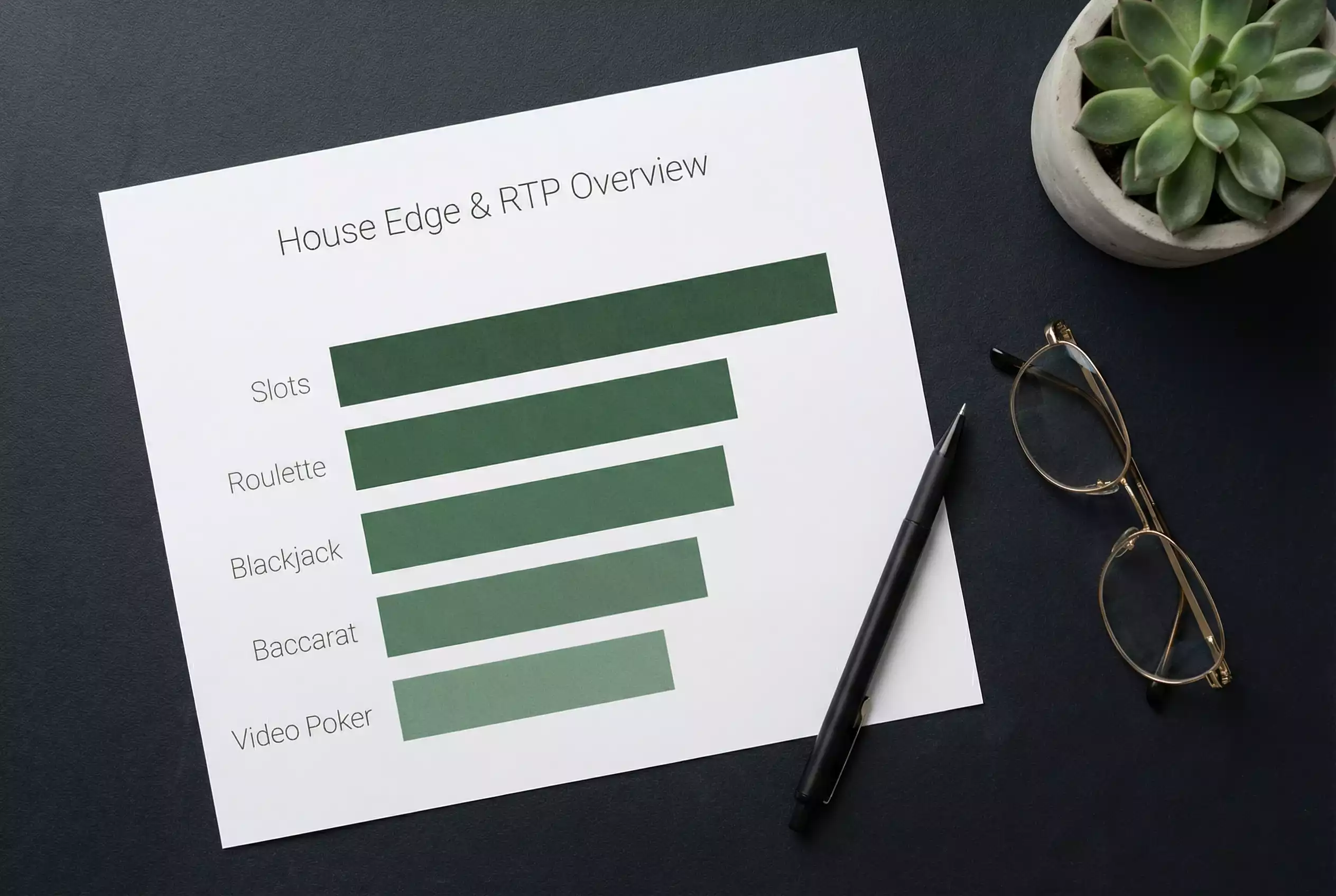
House Edge in Practice: European Roulette
RTP: 97.3% | House edge: 2.7%
If you wager a total of £1,000 across an evening session:
Expected loss = £1,000 × 0.027 = £27
This means the casino expects to keep £27 from every £1,000 wagered — not per spin, but across all wagers combined. Your actual result in any given session will deviate from this, often significantly, but the £27 figure represents the mathematical cost of play.
A point that catches many players off guard: the house edge applies to total wagers, not to your initial deposit. If you deposit £100 and play roulette at £5 per spin, making 200 spins over a session, your total wagered amount is £1,000 — assuming you are recycling winnings. The expected loss is calculated on that £1,000, not on your original £100. This is why even a modest house edge can erode a bankroll faster than it appears on paper.
RNG — Random Number Generator: the algorithm certifying that each spin, hand, or round outcome is independent and unpredictable. Every UKGC-licensed game uses an RNG audited by an independent testing body such as eCOGRA or GLI, ensuring that published RTP figures accurately reflect the game's long-term behaviour.
Deposits, Withdrawals and Payout Speed
Getting money in is instant. Getting money out is where casinos reveal their true nature. Every UK casino accepts Visa debit deposits within seconds. The variation lies almost entirely on the withdrawal side — how long a casino takes to release your funds, which methods it supports for cashouts, and how it handles its internal processing queue.
The withdrawal process follows a predictable sequence: you request a cashout, the casino places it in a pending queue, an internal team approves it, and funds are released to your payment method. The pending period — typically 0 to 48 hours — is where the most variance occurs. A site that processes withdrawals in under an hour is making a deliberate choice to prioritise speed. A site with a 48-hour pending period is making the opposite choice.
Your first withdrawal will almost always take longer because it triggers KYC verification — identity documents, proof of address, and occasionally source-of-funds checks for larger amounts. Completing KYC proactively, before you need to withdraw, eliminates the most common payout delay.
Payment Methods Compared: E-Wallets, Cards and Bank Transfer
The choice of payment method affects both the speed and the flexibility of your casino transactions. E-wallets — PayPal, Skrill, and Neteller — consistently deliver the fastest withdrawal times among non-cryptocurrency options. Debit cards are the most universally accepted method but carry longer bank processing times. Bank transfers offer the highest limits but the slowest speeds.
| Method | Deposit Speed | Withdrawal Speed | Typical Limits | Notes |
|---|---|---|---|---|
| PayPal | Instant | 0–24 hours | £10–£5,000 | Widely accepted; some bonuses exclude PayPal deposits |
| Visa Debit | Instant | 1–3 business days | £10–£10,000 | Universal acceptance; withdrawal time depends on bank |
| Skrill | Instant | 0–24 hours | £10–£5,000 | Fast but sometimes excluded from bonus eligibility |
| Neteller | Instant | 0–24 hours | £10–£5,000 | Similar to Skrill; account fees apply if inactive |
| Apple Pay | Instant | Not always available | £10–£2,000 | Deposit-only at many casinos; check withdrawal support |
| Bank Transfer | 1–3 days | 3–5 business days | £20–£50,000+ | Highest limits; slowest processing; best for large cashouts |
| Paysafecard | Instant | Not available | £10–£1,000 | Deposit-only prepaid voucher; cannot withdraw to it |
A practical consideration many guides overlook: not every deposit method can be used for withdrawals. Apple Pay and Paysafecard are deposit-only at most UK casinos. If you deposit with a method that does not support withdrawals, the casino will typically default to a bank transfer for cashouts — adding days to your payout timeline. The simplest rule is to deposit using the same method you plan to withdraw to.
Do
- Complete KYC verification before requesting your first withdrawal
- Use e-wallets if payout speed is your priority
- Deposit with the same method you intend to withdraw to
- Check the casino's stated processing times before you deposit
Don't
- Ignore withdrawal limits — daily, weekly, and monthly caps vary widely
- Use a deposit-only method and assume you can withdraw to it later
- Skip reading the T&C section on payout caps and pending periods
- Reverse a pending withdrawal — this is how casinos count on you losing it back
Which Casinos Pay Out Fastest in the UK
Payout speed claims on casino homepages should be treated as aspirational. The numbers that matter are tested times — the interval between clicking "withdraw" and seeing funds in your account. In our testing, the fastest e-wallet withdrawals consistently cleared in under two hours, while the slowest debit card cashouts took five business days.
For players who prioritise speed, the formula is straightforward: verify your identity at registration, deposit and withdraw using the same e-wallet, and choose a casino with a track record of minimal pending periods. The combination of these three factors consistently produces the fastest real-world cashout experiences in the UK market.
Is It Safe? UKGC Licensing and Player Protection
The UK Gambling Commission doesn't just hand out licences — it revokes them. In the year to March 2025, the Commission oversaw more than 2,100 licensed operators and took enforcement action including substantial fines against those that failed to meet standards. This is an active enforcement body with the statutory power to suspend licences, impose financial penalties, and refer cases for criminal prosecution.
For players, a UKGC licence guarantees that the operator has passed fit-and-proper-person tests, that its games are audited for fairness, that player funds are segregated from operating capital, and that you have access to independent dispute resolution. No other widely available licence offers the same combination of protections. What it does not guarantee is a perfect experience — the licence is a floor, not a ceiling.
Warning
Always check a casino's licence number against the UKGC public register before depositing. A licence number displayed in a website footer means nothing if it does not match an active, unconditional entry in the register. Some unlicensed operators display fake or expired licence numbers. The verification takes less than a minute and costs nothing.

How to Verify a Casino's UKGC Licence
Verification is a three-step process. First, scroll to the footer of the casino's website and look for a UKGC licence number — it is typically a five- or six-digit number preceded by the text "Licensed by the Gambling Commission" or similar wording. Second, navigate to the UKGC public register at gamblingcommission.gov.uk/public-register/businesses and search for the licence number or the operator's company name. Third, verify that the account status shows as "Active," that the licence type covers "remote casino" activities, and that there are no current conditions or sanctions that might affect player protections.
If the licence number returns no result, or the operator name on the register does not match the brand you are considering, do not deposit. If the licence is listed as "surrendered," "revoked," or "suspended," the casino is not currently authorised to offer gambling services to UK players. This check takes sixty seconds and eliminates the vast majority of risk associated with choosing an online casino.
New UK Gambling Rules 2025–2026: What's Changed
The UK gambling landscape has shifted more in the past two years than at any point since the Gambling Act 2005 was passed. The changes stem from the Gambling Act Review White Paper published in 2023, which triggered a series of consultations and regulatory amendments that are still rolling out through 2026.
The most impactful change for slot players took effect in spring 2025: statutory stake limits of £5 per spin for adults aged 25 and over from 9 April, and £2 for those aged 18 to 24 from 21 May (GOV.UK consultation response). These limits apply to all online slots on UKGC-licensed sites and represent the first time online slots have been subject to the same kind of statutory caps that land-based gaming machines have carried for years. The measure was introduced specifically to address evidence that high-stake online slots were associated with binge gambling and significant financial harm among younger adults.
From 30 June 2026, all online operators must provide customers with the option to set a deposit limit based solely on gross deposits — the total amount paid into the account, without deducting withdrawals. This standardisation eliminates the confusing "net deposit limit" structures that some operators previously used, which could give players a misleading picture of how much they were actually spending. Only gross deposit limits may carry the name "deposit limit" under the new rules. Operators can still offer other limit types — loss limits, session limits — but the terminology must be clearly differentiated.
Additional changes include mandatory financial vulnerability checks since August 2024 (lowered to the £150 threshold from February 2025), a ban on mixed-product bonuses, granular marketing consent requirements since May 2025, and incentive offer restrictions from January 2026. The Remote Gaming Duty is set to increase from 21% to 40% from 1 April 2026 (GOV.UK, November 2025), squeezing operator margins and expected to contribute to a reduction in the number of licensed operators. For players, the net effect is a tighter, more protective regulatory environment.
You've confirmed the licence checks out. Now check if the site actually works on the device you'll use most.
Mobile Casino: Playing on the Go in the UK

If a casino's mobile experience is worse than its desktop, it's not a mobile casino — it's a compromise. With the majority of UK online casino sessions now happening on smartphones, a casino that treats mobile as an afterthought is a casino that does not respect where its players actually are. The question is no longer whether you can play on your phone. It is whether the experience is good enough that you would choose to.
The native app versus mobile browser debate has largely resolved itself in favour of the browser. Most UK casinos use responsive web design that delivers near-app performance without requiring a download — no storage footprint, instant updates, and no App Store dependencies. The few casinos still offering native apps do so for brand presence and push notifications rather than gameplay advantage.
Where mobile performance genuinely varies is in live dealer streaming. A live blackjack table on a 6.5-inch screen with weak 4G is a fundamentally different experience from the same table on a desktop with fibre. The best mobile casinos have optimised their live interfaces for touch — larger bet buttons, simplified controls, adaptive video quality. The worst still serve a scaled-down desktop interface that requires pinch-zooming to place a bet.
Testing is straightforward. Load the casino in your phone's browser, open a game, and check whether it loads in under three seconds with a purpose-built interface. Then try a live dealer table — if the stream is smooth and the controls are thumb-friendly, the casino takes mobile seriously. Always play live dealer games on Wi-Fi or 5G; mobile data introduces latency that can cause bet-placement issues during timed rounds.
Responsible Gambling: Tools Every Player Should Use
The best gambling tool is the one you set before you start playing. Responsible gambling features are not emergency brakes for people who have already lost control. They are standard risk management instruments — the equivalent of setting a budget before going shopping, or deciding how many drinks you will have before you go out. Framing them as "problem gambler" tools is both inaccurate and counterproductive, because it discourages the vast majority of players from using features that would make their experience measurably better.
Every UKGC-licensed casino is required to offer deposit limits, and from 30 June 2026 the standard for what counts as a deposit limit will be tightened to gross deposits only — the total you put in, not a net figure adjusted for withdrawals (Gambling Commission, October 2025). Beyond deposit limits, most operators provide loss limits (capping how much you can lose in a period), session time limits (alerting you or logging you out after a set duration), cooling-off periods (blocking access for 24 hours to 6 weeks), and full self-exclusion.
GamStop is the UK's national self-exclusion scheme. Registering with GamStop locks you out of all UKGC-licensed online gambling sites for a minimum of six months, with options for one year or five years. It is a significant step — and it works, in the sense that the technical integration across the industry is now robust enough that attempting to create a new account at a licensed site after registering will be flagged and blocked. GamStop does not cover unlicensed offshore sites, lottery products, or land-based venues, but for online casino players, it is the most comprehensive self-exclusion tool available.
The practical advice is simple: set a deposit limit when you register. Not because you think you need one, but because it removes a decision you should not be making in the middle of a session. A deposit limit decided calmly on a Tuesday afternoon is a better decision than a deposit limit reconsidered at 1am on a Saturday after a losing run. Similarly, session time reminders — typically set at 30-minute or 60-minute intervals — serve as a neutral check-in, not a judgement. They remind you that time has passed, which is useful information when playing a game specifically designed to obscure the passage of time.
If gambling is causing financial stress, relationship problems, or emotional distress, support is available. GamCare provides free counselling and a 24-hour helpline. The National Gambling Helpline can be reached on 0808 8020 133. BeGambleAware offers information, advice, and referral services. These resources exist precisely so that no one has to navigate gambling-related difficulties alone.
Common Questions About UK Real Money Casinos
How do I know if a UK online casino is safe and fair?
The most reliable indicator is a valid UKGC licence. Check the casino's footer for a licence number, then verify it against the Gambling Commission's public register at gamblingcommission.gov.uk. A licensed casino is required to use independently audited random number generators — tested by bodies like eCOGRA or GLI — to ensure game outcomes are genuinely random. Player funds must be held separately from operating capital, and you have the right to escalate unresolved disputes to an approved Alternative Dispute Resolution provider. SSL encryption protects your data in transit, but the licence is the foundation. If the licence is not valid, nothing else matters.
How do wagering requirements work on casino bonuses?
A wagering requirement is a multiplier that determines how much you must bet before bonus funds can be withdrawn. Since 19 January 2026, UK casinos are capped at 10x wagering. So a £50 bonus at 10x means you must place £500 in total wagers before the bonus balance becomes withdrawable cash. Game contribution rates affect how efficiently you clear the requirement: slots typically contribute 100%, while table games may contribute only 10% to 20%. Time limits apply — most bonuses expire within 30 days. Exceeding the maximum bet cap during active bonus play can void the bonus entirely. Always read the full terms before depositing.
How long do UK online casino withdrawals take?
Withdrawal speed depends on the payment method and the casino's internal processing time. E-wallets like PayPal, Skrill, and Neteller typically deliver funds within 0 to 24 hours once the casino approves the request. Debit card withdrawals take 1 to 3 business days after approval. Bank transfers are the slowest, usually requiring 3 to 5 business days. The main variable is the casino's pending period — the time between your request and their approval — which ranges from instant to 48 hours. Your first withdrawal will take longer due to KYC identity verification. Completing verification at registration, before you need to withdraw, is the single best way to speed up the process.
The £10 Test
Here's a rule that saves more money than any bonus: deposit £10 before you deposit £100. The £10 test is the simplest, most effective way to evaluate a real money casino without risking anything meaningful. It tells you more than any review — including this one — because it reveals how the casino actually treats you when real money is on the line.
Here is what the test covers. Deposit £10 using your preferred payment method and note how long it takes and whether the process is straightforward. Play a few games — a slot, a table game, maybe a live dealer round — and assess the experience on the device you will actually use. Then request a withdrawal of whatever remains. This is the critical step. How long does the casino take to process it? Do they ask for KYC documents you were not warned about? Does the withdrawal go smoothly, or does the site push you toward reversing it and continuing to play?
A casino that handles a £10 withdrawal with the same professionalism it would apply to a £1,000 withdrawal is a casino that has earned a larger deposit. A casino that makes the process slow, confusing, or deliberately inconvenient has told you everything you need to know — and it has cost you ten pounds instead of a hundred to learn it.
The £10 test reframes the entire selection process. Instead of relying on rankings, reviews, or bonus headlines, you are gathering first-hand evidence from the only perspective that matters: yours. No guide can replicate the experience of seeing your own money move through a system. Use the information in this article to narrow your options. Then let ten pounds do the final talking.