Live Game Shows: Crazy Time, Deal or No Deal & More
Best Non GamStop Casino UK 2026
Loading...
Live Game Shows: Where Casino Meets Television
Live casino game shows are the fastest-growing category in UK online gambling, and they don’t look or feel like anything else in a casino. There are no cards, no roulette wheels (mostly), and no requirement to understand complex rules or memorise strategy charts. Instead, there’s a presenter in a television studio, a giant spinning wheel or a set of numbered boxes, and a chat window full of players reacting in real time. It’s gambling crossed with light entertainment, and it has attracted a demographic that traditional table games never reached.
Evolution, the studio behind virtually every major live game show, understood something that the rest of the industry was slow to recognise: a large segment of potential casino players isn’t interested in mastering blackjack strategy or calculating roulette odds. They want to be entertained, to feel part of something happening in the moment, and to have a simple, intuitive betting experience that doesn’t require homework. Live game shows deliver exactly that, with production values that rival primetime television.
The trade-off, as always, is mathematical. Game shows carry house edges that sit between traditional table games and standard slots — typically 3.5% to 5.5% depending on the specific game and bet type. They’re not the cheapest games in the casino per pound wagered, but they’re not the most expensive either. What you’re paying for, beyond the mathematical cost, is an entertainment experience that no other casino format replicates. Whether that premium is worth it depends on what you value more: optimised return percentages or an engaging, social, visually spectacular way to gamble.
How Live Casino Game Shows Work
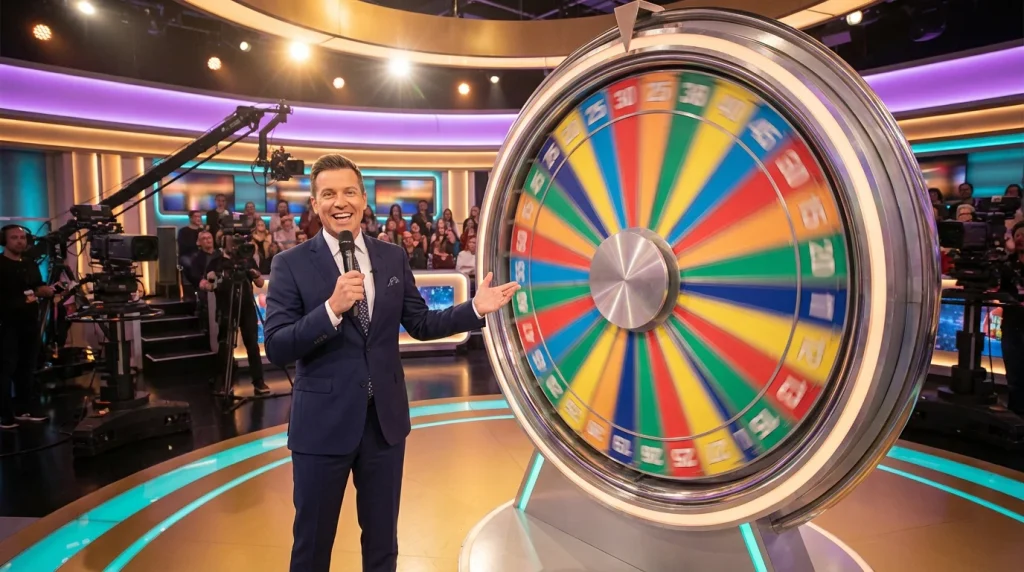
Every live game show streams from a purpose-built studio, typically one of Evolution’s facilities in Riga, Latvia, or their newer operations in other European cities. A real presenter hosts the game, operating physical equipment — spinning wheels, drawing cards, opening boxes — while cameras broadcast the action to thousands of simultaneous players. The games run on fixed schedules, with rounds occurring every 30 seconds to several minutes depending on the format. Between rounds, the presenter fills time with chat, reactions to player wins, and general banter that maintains the television-show atmosphere.
The betting interface appears as an overlay on the video stream. Before each round begins, you have a betting window to place your wagers on available outcomes. The options vary by game: segments on a wheel, numbers behind flaps, colours, multiplier positions, or specific bonus game entries. Once the betting window closes, the presenter initiates the round, and the result plays out live on camera. Wins are credited to your balance immediately after the round concludes.
The technical infrastructure is impressive. Multiple camera angles capture every detail of the game mechanism, ensuring transparency. Optical character recognition technology reads physical results in real time and translates them to the digital interface. Certified RNG elements are integrated where games require random multiplier generation or bonus selection, combining physical gameplay with digital randomisation. The entire operation is monitored by regulators and audited by independent testing labs, just like any other licensed casino game.
Interaction is a core element. The chat window allows you to communicate with the presenter and other players in real time. Presenters are trained entertainers who respond to chat messages, congratulate winners, and maintain energy across multi-hour shifts. This social dimension distinguishes game shows from every other casino format: you’re not playing alone against an algorithm, you’re part of a shared experience with a live host and a visible community. Whether you find this engaging or distracting depends on personal preference, but its effectiveness in retaining players is evident from the category’s growth.
Most game shows operate 24/7, with presenters rotating in shifts. The production quality doesn’t vary by time — a Tuesday morning round runs with the same cameras, lighting, and professionalism as a Saturday night peak session. Player volume fluctuates (peak hours mean busier chat and higher jackpot accumulation on some games), but the game mechanics and odds are identical regardless of when you play.
The Most Popular Live Game Shows at UK Casinos
Crazy Time is the category’s defining title and the one most UK players encounter first. Built around a large vertical money wheel divided into numbered segments and four bonus game positions, it offers a mix of straightforward number bets and elaborate bonus rounds. The four bonus games — Cash Hunt (a shooting gallery with hidden multipliers), Pachinko (a physical puck-drop board), Coin Flip (a two-sided coin with dynamic multipliers), and Crazy Time (a wheel-within-a-wheel with multiplied segments) — are where the game’s biggest payouts live. Top multipliers on the Crazy Time bonus have exceeded 20,000x, though landing on the bonus segment and then hitting the maximum multiplier within it represents extremely long odds. The base game RTP varies by bet type: number segments offer roughly 95.5%, while bonus segment bets range from 94% to 95.5% depending on which bonus you target.
Monopoly Live combines the money-wheel format with a 3D Monopoly board bonus round. The base game spins a wheel with number segments (1, 2, 5, 10) and two bonus positions (2 Rolls and 4 Rolls). Landing on a bonus position triggers a virtual Monopoly board where Mr. Monopoly walks around collecting multiplied payouts. The property values and chance/community chest cards create variable outcomes that can produce wins up to several thousand times the base bet. The game’s RTP sits around 96.23% on the number bets and 91-93% on bonus bets — a significant spread that most players don’t realise.
Dream Catcher is the simplest game show, and the one that started the genre. A 54-segment money wheel with multiplier segments (2x and 7x) that amplify the next spin’s payout. The gameplay is pure: bet on a number, spin the wheel, collect if it lands. No bonus rounds, no secondary mechanics. The simplicity makes it accessible to complete beginners, but the house edge is relatively high across all segments (around 3.4% to 7.7% depending on the bet). Dream Catcher is best understood as an entry point to the game show format rather than a long-term game of choice.
Deal or No Deal Live adapts the television format with a three-phase structure: a qualifying round (spinning a three-reel slot machine to set your opening briefcase value), the game itself (opening briefcases and receiving banker offers), and the final decision. The game adds a strategic element absent from wheel-based shows — you can accept the banker’s offer at any point or gamble on better outcomes remaining. However, the qualifying round adds a layer of cost (you must qualify before playing each round), and the overall RTP is approximately 95.4%. The combination of the familiar television format with real-money stakes creates an engaging experience, particularly for players who watched the original show.
Lightning Dice and Lightning Roulette blend traditional game mechanics with the game-show presentation. Lightning Roulette plays as standard European roulette but adds randomly generated multipliers (50x-500x) to one to five straight-up numbers each round. The trade-off: standard straight-up payouts are reduced from 35:1 to 29:1 to fund the multiplier feature. This means the base game return on straight-up bets is lower than standard roulette, but the occasional lightning multiplier creates dramatic win potential. The overall RTP is 97.30% for outside bets and 97.10% for straight-up bets, with the latter redistributing returns toward rare lightning events and away from standard straight-up payouts.
Pragmatic Play has entered the game show space with titles like Sweet Bonanza CandyLand and Mega Wheel, offering alternatives to Evolution’s dominance. While the production quality is slightly below Evolution’s benchmark, these games provide variety and are available at casinos that may not carry the full Evolution catalogue. The mechanics follow similar patterns — wheel spins, bonus rounds, live presenters — with RTPs in the 95-96% range.
RTP vs Entertainment: The Real Cost of Playing Game Shows
The mathematical cost of game shows sits in a middle tier among casino games. They’re cheaper per pound wagered than most slots (where house edges of 4-6% are standard) but more expensive than table games like blackjack (0.5%) or baccarat (1.06%). The typical game show house edge of 3.5-5.5% translates to an expected cost of £3.50-£5.50 per £100 wagered — broadly comparable to European roulette at £2.70 per £100, and substantially better than the worst slots at £8-£12 per £100.
However, the pace of game shows moderates the hourly cost compared to slots. A slot player might complete 600 spins per hour at high speed. A game show round takes 30 seconds to several minutes, and the betting window, presentation, and result delivery mean you’re placing far fewer bets per hour. At Crazy Time, you might complete 30-40 rounds per hour with £1 bets, wagering £30-£40 total. At a slot, the same £1 per spin could produce £600 in hourly wagers. The hourly cost of game show play is therefore significantly lower than slots, even if the per-bet house edge is similar, simply because the format naturally limits betting frequency.
This slower pace is part of the entertainment proposition. Each round is a self-contained event with buildup, tension, and resolution. The presenter’s commentary adds narrative structure. The chat creates community. The bonus rounds deliver multi-stage excitement that a single slot spin can’t replicate. You’re paying for this experience through the house edge, and whether that’s a fair exchange depends entirely on how much value the entertainment holds for you personally.
One area where game shows can become expensive is bonus-chasing behaviour. The bonus segments on games like Crazy Time and Monopoly Live are where the biggest wins live, and some players concentrate their bets exclusively on bonus positions. These bets have lower RTPs than number bets (sometimes significantly lower), which means the entertainment premium for pursuing the most exciting outcomes is mathematically steeper. Balanced betting across number segments and bonus positions reduces the overall house edge compared to bonus-only strategies.
The Show Must Go On
Live game shows have carved a permanent place in UK online casinos because they deliver something no other format can: the energy and spectacle of live television combined with real-money gambling. They’re accessible to players who find table games intimidating and engaging enough to retain players who’ve grown bored of spinning reels. The presenters, the production, the shared experience of a hundred players watching the same wheel spin — it’s a category built on entertainment first and gambling mechanics second.
The cost is real but proportionate. Game show house edges are moderate, the natural pace limits hourly spend, and the entertainment per pound is arguably higher than any other casino format. If you choose to play, pick games with transparent RTP information, spread bets across segments rather than exclusively chasing bonus positions, and set a session budget that reflects the entertainment value rather than the hope of a windfall. The show runs 24/7. It will still be broadcasting when you come back.