KYC Verification at UK Casinos: Documents & Process
Best Non GamStop Casino UK 2026
Loading...
KYC at UK Casinos: Why Every Operator Needs to Know Who You Are
KYC stands for Know Your Customer, and at UK online casinos it’s a mandatory identity verification process that every player must complete. It’s not optional, it’s not a bureaucratic formality, and it’s not something the casino invented to inconvenience you. It’s a legal requirement imposed by the UK Gambling Commission and reinforced by anti-money-laundering legislation that applies to all financial services, including gambling operators.
The practical impact on players is straightforward: before you can withdraw winnings, the casino needs to confirm that you are who you say you are, that you live where you say you live, and that the money you’re depositing comes from a legitimate source. This typically involves submitting photographs of identity documents and, in some cases, proof of your financial situation. The process can be quick (minutes, with automated verification) or slow (days, with manual document review), depending on the casino and the quality of the information you provide.
Most player frustration with KYC stems from timing rather than principle. Nobody objects to identity verification in theory — it protects against fraud, underage gambling, and money laundering. The frustration comes when it delays a withdrawal, particularly when the player wasn’t expecting it. This guide explains what KYC requires, which documents you need, and how to complete verification before it becomes a barrier between you and your money.
What KYC Requires: The Three Pillars of Identity Verification
UK casino KYC verification operates across three pillars, each serving a distinct regulatory purpose. Not every casino requires all three upfront — some complete the first two automatically and only request the third when triggered by specific thresholds — but understanding all three prepares you for every scenario.
The first pillar is identity verification: confirming that you are the person named on the account. This requires a government-issued photo ID that shows your full name, date of birth, and photograph. The casino matches the name and date of birth on the document to the details you provided during registration. If there’s a discrepancy — a middle name you omitted, a maiden name versus married name, a slight spelling variation — the verification can fail or require additional clarification. Accuracy during registration is the simplest way to prevent this.
The second pillar is address verification: confirming that you live at the address you registered with. This typically requires a recent document (dated within the last three months) that shows your name and home address. Utility bills, bank statements, council tax letters, and government correspondence are the most commonly accepted formats. The address on the document must match the address on your casino account. Casinos use this check to confirm your UK residency (which determines their licensing obligations) and to ensure your account isn’t registered to a fictitious or transient address.
The third pillar is source of funds verification, and this is the one that catches many players off guard. UKGC regulations require casinos to verify that the money you’re gambling with comes from legitimate sources when certain triggers are met — typically when your deposits exceed a particular threshold or when your gambling patterns suggest higher-than-normal spending. Source of funds checks can require payslips, bank statements, tax returns, proof of savings, evidence of property sales, or other documentation that explains where your money comes from. The threshold at which these checks are triggered varies by operator and is not always disclosed.
Automated verification handles the first two pillars at many modern UK casinos. During registration, the casino runs your name, date of birth, and address through electronic verification databases (credit reference agencies, electoral roll data) to confirm your identity without requiring document uploads. If the automated check succeeds, you’re verified instantly. If it fails — because your details don’t match the databases, you’re new to the electoral roll, or there’s an address discrepancy — you’ll be asked to submit documents manually.
The trend in the UK market is toward earlier verification. Several operators now require complete KYC before allowing the first deposit, rather than deferring it until the first withdrawal. This front-loads the administrative burden but eliminates the withdrawal delay that frustrates so many players. Casinos that verify on registration are, from a player experience perspective, the better option — even though the initial process takes a few extra minutes.
Accepted Documents: What to Prepare and What Gets Rejected
The specific documents accepted vary between casinos, but a standard set covers the vast majority of UK operators. Having these ready before you register — or at minimum, before your first withdrawal — eliminates the scramble that delays so many verification processes.
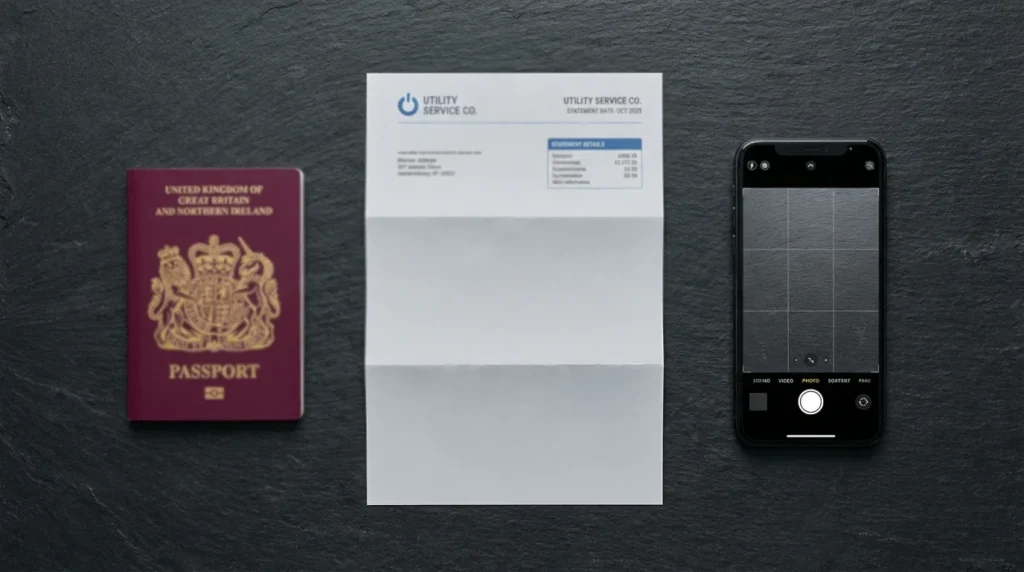
For identity verification, the universally accepted documents are a valid UK passport and a UK driving licence (full or provisional, photocard version). Some casinos also accept EU/EEA national identity cards, biometric residence permits, and certain other government-issued photo IDs. Expired documents are almost always rejected — the photo ID must be within its validity period. Paper driving licences (the old green or pink paper format without a photo) are not accepted because they lack a photograph.
For address verification, the most reliable documents are a utility bill (gas, electricity, water, landline phone) dated within the last three months, a bank or building society statement from the same period, a council tax bill for the current year, or a letter from HMRC dated within the last twelve months. Mobile phone bills are accepted by some operators but not others — if in doubt, use a utility bill or bank statement. Documents must show your full name and current address. Online statements and bills are generally accepted provided they show the provider’s letterhead, your name, your address, and the date. Screenshots of account pages are typically rejected because they’re too easy to manipulate.
For source of funds, the documentation depends on what your income or wealth source is. Employed individuals usually need recent payslips (last three months) and sometimes a bank statement showing salary deposits. Self-employed individuals may need tax returns, accounts, or business bank statements. Those relying on savings need bank statements showing the account balance and transaction history. Pension recipients need pension statements. Property sellers need completion statements from solicitors. The key principle: the documentation must create a credible link between a legitimate income source and the money appearing in your casino account.
Common reasons for document rejection include: images that are blurry, cropped, or partially obscured; documents that have expired; address discrepancies between the document and the account; documents in a foreign language without a certified translation; and scanned copies of documents that the casino requires as photographs (some operators specifically require a photo of the physical document, not a scan or PDF). Taking clear, well-lit photographs with all four corners of the document visible is the most reliable approach.
How to Speed Up KYC and Avoid Withdrawal Delays
The single most effective step is completing verification immediately after registration, before your first deposit. Most UK casinos allow you to upload documents through the account settings or verification section at any time. Upload your photo ID and proof of address on day one, and by the time you make your first withdrawal, the verification is already complete. This approach eliminates the most common source of payout frustration: the surprise document request that appears only after you’ve requested a withdrawal.
When uploading documents, ensure the images are clear and complete. Lay the document flat on a dark, contrasting surface. Photograph it straight-on with even lighting and no shadows. Include all four corners. Make sure the text is legible and the photograph (on ID documents) is clearly visible. A one-minute investment in image quality saves days of back-and-forth if the casino rejects a blurry or cropped submission.
Use the same name format everywhere. If your passport reads “James Robert Smith” but you registered as “Jim Smith,” the mismatch can delay automated verification and require manual review. Register at the casino with your name exactly as it appears on your primary ID document, including middle names if shown. This applies to your address too — “Flat 3, 42 High Street” is not the same as “3/42 High St” for database matching purposes.
Keep your documents current. An expired passport means you’ll need to use your driving licence instead, and if that’s also expired, you’re facing a delay until one is renewed. Similarly, keep recent utility bills or bank statements accessible — once a document passes the three-month threshold, it’s no longer valid for address verification. A simple habit of saving the most recent bill in a dedicated phone folder ensures you always have a current address document ready.
If your casino offers electronic verification during registration (an automated database check rather than document upload), complete it honestly and accurately. The check runs against credit reference agencies and the electoral roll, so being on the electoral register at your current address significantly increases the likelihood of instant verification. If you’ve recently moved and haven’t updated your electoral registration, do so before registering at a new casino — it smooths the process considerably.
Finally, respond to verification requests promptly. If the casino contacts you requesting additional documents, the clock on your withdrawal processing doesn’t start until the documents are received and approved. Every day of delay between the request and your response is a day added to the withdrawal timeline. Treat verification requests with the same urgency you’d give a delivery notification — the faster you respond, the faster you get what you’re waiting for.
Verify Once, Play Freely
KYC is the price of admission to regulated online gambling in the UK, and it’s a price worth paying. The process protects you from identity fraud, protects minors from accessing gambling, and protects the financial system from money laundering. It’s also, once completed, entirely behind you. A verified account processes withdrawals without document review, without delays, and without the anxiety of wondering whether your payout will be held up by a compliance check.
The ten minutes it takes to upload clear documents and complete verification is an investment that pays off on every subsequent withdrawal for the lifetime of your account. Do it first. Do it once. Then forget about it and focus on the games.