Best Mobile Casino Apps UK
Best Non GamStop Casino UK 2026
Loading...
Mobile Casino in the UK: App vs Browser and Why It Matters
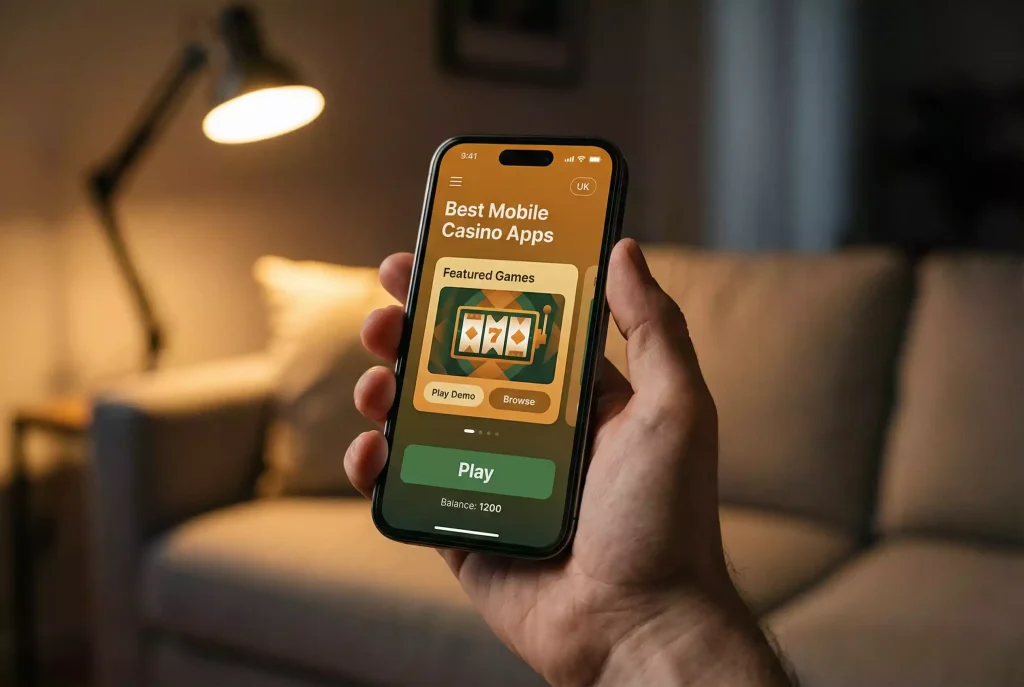
The majority of UK casino play now happens on mobile — but not all mobile experiences are equal. Some operators have invested heavily in native apps with smooth navigation, optimised game loading, and live dealer interfaces that genuinely work on a 6-inch screen. Others have wrapped their desktop site in a responsive template and called it a day. The difference between these two approaches is the difference between a casino you’ll actually use on your phone and one you’ll abandon after three sessions.
The mobile shift in UK gambling didn’t happen gradually. It accelerated sharply between 2020 and 2023, driven by improved mobile hardware, faster connections, and the simple reality that most people reach for their phone before they open a laptop. Operators responded by either building dedicated iOS and Android apps or optimising their browser experience for touchscreens — and the best ones did both. Today, any UKGC-licensed casino that doesn’t perform well on mobile is essentially conceding the majority of its potential audience.
What makes a good mobile casino isn’t simply a smaller version of the desktop site. It’s a rethinking of navigation, game discovery, account management, and the deposit-to-play flow for a screen you operate with one thumb. The casinos that get this right load games faster, place key actions within easy reach, and deliver live dealer streams without constant buffering. The ones that don’t leave you pinching, zooming, and waiting — which is not how anyone wants to spend their leisure time.
This guide breaks down the native app versus mobile browser debate, highlights which UK casinos lead on mobile in 2026, and covers the practical settings that make the experience smoother regardless of which platform you choose.
Native Apps vs Mobile Browser: Which Is Better
Native apps load faster and push notifications — browser play needs no download and updates instantly. That’s the headline version. The full picture is more nuanced, and the right choice depends on how you play, how often, and how much storage you’re willing to sacrifice.
A native casino app, downloaded from the App Store or Google Play, installs directly on your device. It stores assets locally, which means the interface loads faster and consumes slightly less data per session than a browser-based equivalent. Navigation tends to feel more fluid because native apps can leverage device-specific gestures and animations. Push notifications keep you informed about promotions and bonus expiry dates — useful if you opt in, irritating if you don’t. The key advantage is performance consistency: a well-built native app delivers the same experience every time you open it.
The downsides are real, though. Native apps occupy storage space, typically between 50MB and 200MB depending on the operator. They require manual updates through the app store, and those updates sometimes introduce bugs that take days to patch. Apple’s App Store policies historically created friction for real-money gambling apps, requiring additional verification steps and imposing restrictions on promotional content within the app. Google Play has been more permissive, but still limits real-money gambling apps to specific regions — the UK being one of them, fortunately.
Browser-based mobile casinos run in Safari, Chrome, or whichever browser you prefer, accessed through the casino’s URL. Modern HTML5 technology means there’s no Flash dependency and no plugin requirements. You bookmark the site, tap it, and play. The primary advantage is immediacy: no download, no updates, no storage consumed. Any changes the operator makes go live instantly without requiring you to update anything. Browser play also makes it trivially easy to switch between casinos without cluttering your home screen with apps.
Performance-wise, the gap has narrowed considerably. Five years ago, native apps were noticeably faster. In 2026, a well-optimised mobile site on a modern phone is nearly indistinguishable from a native app during gameplay. Where the difference persists is in ancillary features: push notifications remain app-exclusive, biometric login (Face ID, fingerprint) tends to be more reliable in native apps, and some operators reserve exclusive game titles or bonuses for app users.
Live dealer games present the clearest test case. Streaming a live video feed to your phone demands stable bandwidth regardless of whether you’re in an app or browser. In practice, native apps handle stream quality adjustments slightly more gracefully — stepping down resolution seamlessly when your connection weakens — while browser streams are more likely to stutter or display a loading indicator. If live casino is your primary interest, a native app has a tangible edge.
For most UK players, the pragmatic approach is to use the mobile browser to test a casino before committing to the app. If you find yourself returning regularly, download the app for the smoother experience. If you rotate between several casinos, browser play keeps things clean and storage-light. There’s no wrong answer — only the one that matches your habits.
Best Mobile Casino Apps UK 2026
These apps earned top marks for speed, stability, and not feeling like shrunken desktop sites. The distinction matters more than you might think. A casino can have an excellent game library and generous bonuses yet deliver a mobile experience that makes you want to close the app within minutes. The operators below have built mobile interfaces that feel intentional rather than afterthought.
The criteria for ranking mobile casino apps differ from desktop rankings in important ways. Game count matters less on mobile — nobody scrolls through 3,000 titles on a phone — and discoverability matters more. Can you find your favourite game in under five seconds? Does the search function work properly? Are recently played games surfaced automatically? These interaction details separate a mobile-first casino from a desktop casino that happens to work on phones.
Speed is the non-negotiable factor. Game loading time on mobile should sit under three seconds on a reasonable connection. Anything longer and the experience feels sluggish, particularly when you’re switching between games or returning to the lobby. The top-performing apps cache game assets intelligently, preloading your most-played titles so they launch almost instantly. Slower apps force a fresh load every time, adding friction to every session.
Live dealer performance on mobile is where the strongest apps separate themselves. Streaming a live table to a phone requires adaptive bitrate streaming — automatically adjusting video quality based on your current bandwidth. The best implementations do this invisibly. You don’t notice the resolution shifting because the transition is smooth. Poor implementations stutter, freeze, or drop to a resolution that makes the cards unreadable. If live casino is part of your play, testing the stream quality before committing to an operator is essential.
Account management deserves attention as well. Depositing, withdrawing, checking bonus status, and contacting support should all be accessible within one or two taps from any screen. Some mobile apps bury the withdrawal function three menus deep, which feels deliberate even when it probably isn’t. The best apps place deposit and withdrawal buttons on equal footing — because making it easy to cash out is as much a sign of confidence as offering fast payouts.
Touch-friendly design sounds obvious, but execution varies wildly. Buttons need to be large enough to tap accurately. Bet adjustment sliders should respond precisely to finger movement without jumping. Table game controls — hit, stand, double, split — need clear visual separation so you don’t misclick during a live hand. These are the details that determine whether you play on your phone by choice or revert to desktop out of frustration.
One emerging differentiator is landscape mode support. Most mobile casino apps default to portrait orientation. For slots, that’s fine. For table games and live dealer, landscape mode provides a significantly better view of the table layout and card details. Operators that support both orientations with graceful transitions score higher on usability. Those that lock you into portrait for everything are leaving a better experience on the table.
Mobile Casino Tips: Battery, Data and Optimal Settings
A few settings adjustments can make your mobile casino experience significantly smoother. None of this is complicated, but the cumulative effect is noticeable — especially during longer sessions or when you’re playing on mobile data rather than Wi-Fi.
Wi-Fi is always preferable to mobile data for casino play. Not because 4G or 5G isn’t fast enough — it generally is — but because Wi-Fi provides more consistent latency. Live dealer games are particularly sensitive to connection stability. A brief data drop-out during a blackjack hand can mean missing your action window, and the game won’t wait for your connection to recover. If you must use mobile data, avoid playing in areas with weak signal and consider closing background apps that consume bandwidth.
Low power mode on both iOS and Android throttles CPU and GPU performance to extend battery life. That throttling directly impacts game loading times and animation smoothness. If your phone dips below 20% and activates low power mode automatically, you’ll notice slots running less smoothly and live streams buffering more frequently. Either charge before you play or manually disable low power mode during your session. Casino apps are graphically intensive — they need full processing power to perform properly.
Clearing your browser cache periodically helps if you play through a mobile browser rather than a native app. Cached data from previous sessions can occasionally cause display glitches or prevent updated game versions from loading correctly. A monthly cache clear is sufficient for most players. On native apps, the equivalent action is checking for app updates — developers push fixes regularly, and running an outdated version is the most common cause of avoidable bugs.
Enable Do Not Disturb mode during sessions. An incoming call during a live dealer hand is more than just annoying — it can disrupt your connection and cost you a bet. Notifications from other apps create the same risk on a smaller scale. A dedicated gaming session benefits from the same focus you’d apply in a physical casino, minus the free drinks.
The Casino in Your Pocket
The best mobile casino is the one you forget you’re using on a phone. When the navigation feels intuitive, the games load instantly, and the deposit-to-play flow takes fewer taps than ordering a coffee, the device disappears. You’re just playing — not fighting an interface.
That seamlessness is the benchmark against which every mobile casino should be measured. If the app makes you conscious of its limitations — slow loading, cramped buttons, buried menus, unreliable streams — then the operator hasn’t invested enough in mobile. Given that the majority of their players are on phones, that underinvestment tells you something about their priorities.
The practical test is simple. Open the casino on your phone. Find your favourite game. Load it. Place a bet. Navigate to the cashier. Start a withdrawal. If any of those steps involves frustration, pinching to zoom, or more than two taps, try a different operator. The casino market in the UK is competitive enough that you don’t need to tolerate a poor mobile experience.
Whether you choose a native app or stick with browser play, the result should be identical: a gambling experience that fits your schedule, your screen, and your one-thumb operating style. Anything that reminds you it’s mobile is a compromise you don’t have to accept.