
Online Blackjack UK: Rules, Strategy & Best Sites
 Available in GB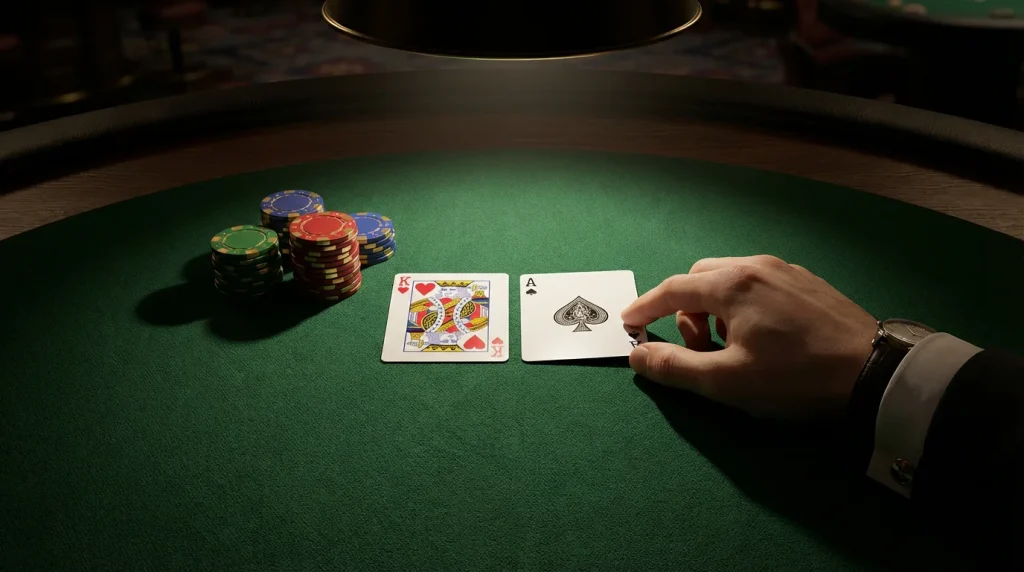
Online Blackjack in the UK: The One Game Where Skill Shifts the Edge
Blackjack stands apart in the casino catalogue for a simple reason: your decisions matter. In slots, the outcome is determined the instant you press spin. In roulette, once the ball is released, you’re a spectator. But in blackjack, every hand presents a genuine decision — hit, stand, double, split — and making the mathematically correct choice consistently can reduce the house edge to under 0.5%. No other standard casino game gives you that level of agency over the odds.
That doesn’t make blackjack a winning proposition. The house still maintains an edge, and over a sufficient number of hands, that edge will grind down any bankroll. What it means is that blackjack offers the smallest mathematical cost per hour of any table game when played correctly. A player using perfect basic strategy at a European blackjack table faces a house edge of roughly 0.4-0.5%, compared to 2.70% at European roulette or 2-5% on most slot games. Over £1,000 in total wagers, the expected loss at blackjack is £4 to £5. At roulette, it’s £27. At slots, it could be £40 or more.
The catch — and it’s a meaningful one — is that achieving that low house edge requires discipline. You need to learn basic strategy: the mathematically optimal play for every combination of your hand and the dealer’s upcard. It’s not complicated (the entire strategy fits on a single card), but it does require committing to decisions that sometimes feel counterintuitive. Standing on 12 when the dealer shows a 6. Doubling down on a soft 18 against a 5. Splitting 8s when the dealer shows a 10. These decisions are correct by the maths, even when your gut disagrees.
This guide covers the rules of online blackjack as played at UK casinos, the complete basic strategy framework, and which sites offer the best blackjack experience — both RNG and live — in 2026.
Blackjack Rules and Basics: How the Game Works
The objective of blackjack is often misunderstood. It’s not to get as close to 21 as possible. It’s to beat the dealer. That distinction matters because it changes how you should think about every hand. Sometimes the correct play is to stand on 13 — a terrible hand by any measure — because the dealer’s upcard suggests they’re likely to bust. Chasing 21 is how beginners lose money. Playing the dealer’s weakness is how experienced players reduce the edge.
Card values are straightforward. Numbered cards (2-10) are worth their face value. Face cards (Jack, Queen, King) are worth 10. Aces are worth either 1 or 11, whichever benefits your hand more. A hand containing an Ace counted as 11 is called a “soft” hand (soft 17, for example, is Ace + 6) because it can’t bust on the next card — the Ace simply drops to 1 if the total would exceed 21. A hand without an Ace, or where the Ace must count as 1, is a “hard” hand.
The game begins with you receiving two cards face up. The dealer receives one card face up (the “upcard”) and one face down (the “hole card”) in most variants, or just one card face up in European no-hole-card rules. You then decide how to act. The core options are: Hit (take another card), Stand (keep your current total), Double Down (double your bet and receive exactly one more card), and Split (if your two cards are a pair, separate them into two hands, each with its own bet). Some variants offer additional options like Surrender (forfeit half your bet to abandon a bad hand) and Insurance (a side bet that the dealer has blackjack when showing an Ace).
After you complete your hand, the dealer plays. In most UK online blackjack games, the dealer must hit on 16 or below and stand on 17 or above. Some variants require the dealer to hit on soft 17 (Ace + 6), which slightly increases the house edge because it gives the dealer an extra chance to improve their hand. The dealer has no decisions — they follow fixed rules — which is why your decisions are the only variable that affects the outcome.
A “blackjack” or “natural” is an Ace plus a 10-value card dealt as your initial two cards. This pays 3:2 at most UK tables (meaning a £10 bet wins £15), though some games have reduced this to 6:5 (£10 bet wins £12). Avoid 6:5 blackjack games wherever possible. The difference between 3:2 and 6:5 adds approximately 1.4% to the house edge — a staggering increase that turns blackjack from one of the lowest-edge games in the casino to one that’s barely better than roulette.
The variants you’ll encounter at UK online casinos include Classic Blackjack (standard rules, typically 1-8 decks), European Blackjack (no hole card; dealer only draws after you complete your hand), Multi-Hand Blackjack (play up to five hands simultaneously), Blackjack Switch (two hands dealt, you can swap top cards between them), and various live dealer versions including Infinite Blackjack (unlimited players, one shared hand with optional side bets) and Lightning Blackjack (random multipliers on wins). Each variant has slightly different house edge figures, and the optimal strategy can vary between them. For standard play, European Blackjack or Classic Blackjack with 3:2 natural payouts offers the lowest house edge.
Basic Strategy: The Mathematically Optimal Way to Play Every Hand
Basic strategy is not a tip or a suggestion. It’s the mathematically proven optimal decision for every possible combination of your hand and the dealer’s upcard, calculated by running millions of simulated hands through a computer. Following basic strategy perfectly doesn’t guarantee you’ll win any particular hand. What it guarantees is that you’re making the decision with the highest expected value every single time, reducing the house edge to its absolute minimum.
The strategy is typically presented as a grid. One axis shows your hand total (or specific hand composition for pairs and soft hands), the other shows the dealer’s upcard (2 through Ace). Each cell tells you the correct action: H (hit), S (stand), D (double down), P (split), or Ds (double if allowed, otherwise stand). The entire chart fits on a credit card. Memorising it takes a few hours of practice. Using it consistently takes discipline.
The key principles behind basic strategy are intuitive once you understand the logic. When the dealer shows a weak upcard (2 through 6), they’re more likely to bust because they must hit until reaching 17. This means you should stand on lower totals (12-16 in many cases) and let the dealer take the risk. When the dealer shows a strong upcard (7 through Ace), they’re likely to make a strong hand, so you need to improve yours — which means hitting on totals you might otherwise stand on.
Doubling down is where basic strategy recovers much of the expected loss. You double when the maths favours you — specifically, when your hand is strong and the dealer’s upcard is weak. The classic double situation is holding 11 against a dealer’s 6. Your most likely next card is a 10 (there are more 10-value cards in the deck than any other value), giving you 21 against a dealer who’s likely to bust. Doubling your bet in this spot maximises your return on a favourable situation. Failing to double when basic strategy says to is one of the most costly mistakes recreational players make.
Splitting pairs follows specific rules. Always split Aces and 8s. Never split 10s or 5s. Split 2s, 3s, 6s, and 7s against weak dealer upcards (2-7) but not against strong ones. Split 4s only against a dealer 5 or 6. Split 9s against most dealer cards except 7, 10, and Ace. These rules exist because each pair creates a specific mathematical situation where splitting either improves your expected value (Aces, 8s) or doesn’t (10s, 5s).
A few decisions feel wrong every time but are mathematically correct. Hitting on 16 against a dealer’s 7 is one. Your 16 will bust often when you hit, and that feels terrible. But standing on 16 against a 7 loses more often in the long run because the dealer will make 17 or better the majority of the time. The strategy isn’t about winning individual hands — it’s about making the choice that loses less over thousands of hands. Insurance, similarly, is almost always a bad bet — the probability of a dealer blackjack doesn’t justify the 2:1 payout, so decline it every time.
One more point on basic strategy: it’s specific to the rules of the game you’re playing. The optimal play with dealer stands on soft 17 differs slightly from the optimal play with dealer hits on soft 17. The number of decks matters too — single-deck strategy differs from six-deck strategy in several spots. Most UK online blackjack uses six or eight decks with the dealer standing on soft 17. Make sure the strategy chart you’re using matches the rules of the table you’re sitting at.
Best Online Blackjack Sites UK 2026
A good blackjack site prioritises three things: favourable rules, low minimum bets, and a live dealer lobby with enough table variety that you’re never forced into a game with suboptimal conditions. The difference between a well-chosen blackjack table and a poorly chosen one can be a full percentage point of house edge — which, over time, represents a significant amount of money.
Rules to look for include: 3:2 natural blackjack payouts (not 6:5), dealer stands on soft 17, doubling allowed on any two cards, doubling allowed after splitting, late surrender available, and fewer decks (all else being equal, fewer decks favour the player). Not every UK online casino offers all of these player-friendly rules simultaneously, but the best blackjack sites offer at least four out of six. A table with 3:2 naturals, dealer stands on soft 17, and double after split allowed will have a house edge around 0.4-0.5% with basic strategy. That’s the target.
Live blackjack has become the dominant format for serious players, and the variety available in 2026 is substantial. Standard seven-seat tables offer the traditional experience: you sit in your own seat, play your own hand, and interact with the dealer at the pace of the table. These typically have minimum bets between £5 and £25. Infinite Blackjack (Evolution) removes the seat limit entirely — all players share the same initial two cards but make independent decisions. This format is ideal for low-stakes play (minimum bets often start at £1) and eliminates the frustration of finding all seats occupied at popular tables.
Speed Blackjack and Lightning Blackjack cater to different player profiles. Speed Blackjack deals to whichever player acts first, incentivising quick decisions and creating a faster-paced game. Lightning Blackjack adds random multipliers to winning hands — up to 25x — in exchange for a “lightning fee” deducted from each initial bet. The multiplier mechanic increases volatility and slightly alters the optimal strategy, so it’s worth understanding the specific rules before playing.
For RNG blackjack, look for titles from established providers like Playtech, NetEnt, or Microgaming. These games use certified random number generators and publish their RTP figures (typically 99.5% or higher for standard rules, confirming the sub-0.5% house edge). RNG blackjack is useful for practice — you can play hands at your own pace without a timer — and for very low-stakes play, with some titles allowing bets from 10p per hand.
One important note on bonuses: blackjack typically contributes just 10% toward wagering requirements at UK casinos. A 35x wagering requirement on a £100 bonus theoretically requires £3,500 in slot wagers, but £35,000 in blackjack wagers to achieve the same result. The economics rarely make sense. If blackjack is your primary game, consider declining the bonus and playing with your own funds. The low house edge means you keep more of your money anyway — adding an unfavourable bonus structure on top only complicates things.
Top online casinos in the UK
- SlotoSportBonus: 500% up to £ 10 200+ 777 FS · Payout speed: 1-3 business days
- BritsinoBonus: Welcome Package – Get your £2,200 + 2,000 FS · Payout speed: 1-3 business days
- JetsetspinsBonus: 200% Bonus + 100 Free Spins + Free Royal Wheel · Payout speed: 1-3 business days
- BeOnBetBonus: 100% up to €500 + 100 FS · Payout speed: 1-3 business days
- DieselwinBonus: Welcome Pack 250% up to £4000 + 200 FS · Payout speed: 1-3 business days
- AmunbetBonus: Join now and get 450% up to 2,700 GBP + 450 FS · Payout speed: 1-3 business days
- SpinFormulaBonus: 550% Up To £15,000 + 550 FS · Payout speed: 1-3 business days
- Revery PlayBonus: 100% up to€1,000+ 100 FS · Payout speed: 1-3 business days
- x3betBonus: Welcome Pack 100% Up to £1.000 + 200 Free Spins · Payout speed: 1-3 business days
- ZombillionBonus: Welcome Pack 250% up to £4000 + 200 FS · Payout speed: 1-3 business days
The Hand You Don’t Play
The most important blackjack skill isn’t knowing when to hit or stand. It’s knowing when to stop. Basic strategy optimises every individual hand, but it doesn’t prevent you from playing too many hands in a session, chasing a losing streak, or increasing your bet size after a string of wins under the false assumption that you’re “due” for a hot run. Each hand is independent. The deck doesn’t remember what happened before, and neither should your bet sizing.
Blackjack offers the closest thing to a fair game you’ll find in any casino. A house edge of 0.4-0.5% with basic strategy means you’re paying roughly £4 to £5 per £1,000 wagered for the entertainment of playing. That’s remarkably cheap compared to almost any other form of gambling. But “cheap per hand” becomes expensive per hour if you play too fast, too long, or with bets that exceed your comfort zone.
Set a session bankroll. Bet no more than 2-5% of that bankroll per hand. Follow basic strategy without deviation. And when the session is over — whether you’re up, down, or exactly where you started — walk away. The hand you don’t play is the one that can’t cost you anything, and sometimes that’s the smartest decision at the table.
Visit bestonlinecasinomoneyuk for the best UK online casino reviews and real money guides.
Discover how Slingo works in our Slingo Games UK guide.